NexCore
An ai computing server manufacturer designs and builds systems for demanding artificial intelligence workloads. These machines often pair high-performance processors with GPUs or other accelerators, fast memory, and high-speed networking. A typical rack may contain dense servers, liquid-cooling pipes, and power connections sized for sustained workloads. The manufacturer’s role extends beyond assembling parts: it must validate performance, manage heat, and support deployment and maintenance. Details matter.
Demand is growing, but the numbers need context. IDC’s 2024 Worldwide AI and Generative AI Spending Guide projected global AI spending of $632 billion by 2028, with a 29% compound annual growth rate from 2023. That figure spans hardware, software, and services; it is not a server-sales forecast. For buyers, the distinction is important. A capable ai computing server manufacturer should explain tested configurations, accelerator compatibility, power requirements, cooling options, and support terms—not just peak performance claims. Independent benchmarks and clearly documented test conditions help make comparisons more reliable. Still, specifications cannot predict every production workload. The boundary between a server maker, an integrator, and a platform provider is not always neat, either. Asking who validates the complete system can reveal gaps that a polished product sheet may miss.
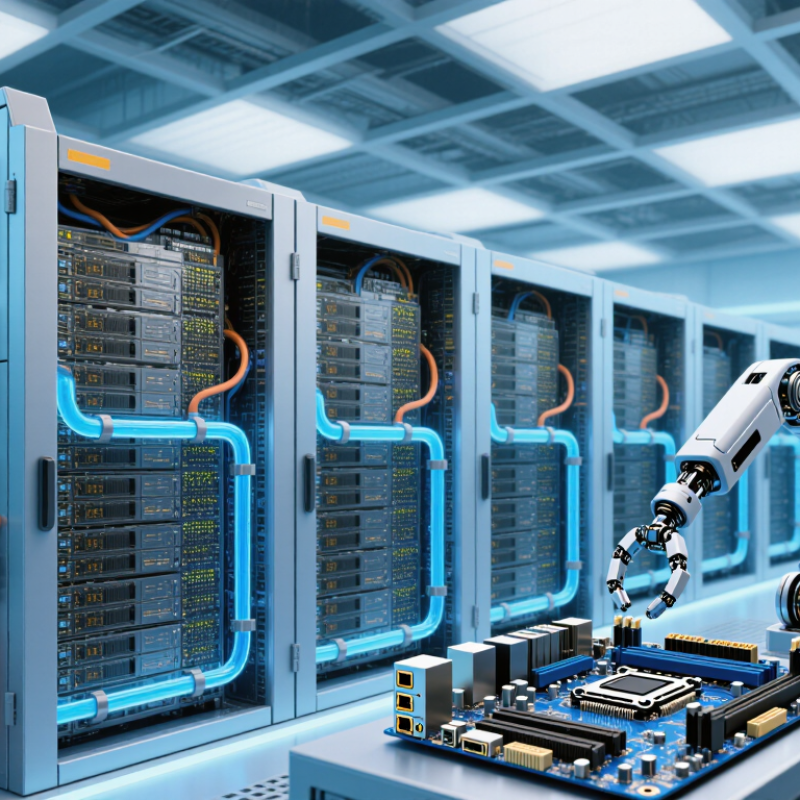
What defines an AI server manufacturer is more than assembling processors and memory. It must design a system that can deliver power, remove heat, and remain stable under sustained workloads. A high-end accelerator rated at 700 watts changes the entire server design. That figure applies to the accelerator, not the complete system.
Heat builds quickly. A chassis may need carefully directed airflow, substantial heatsinks, and fans tuned for dense hardware. Liquid cooling can help in some configurations, but it adds plumbing, monitoring, and maintenance demands. Engineers also need to check power supplies, cabling, and rack capacity. A server that works in a laboratory may behave differently in a warm, crowded data center. That gap matters.
Experienced manufacturers validate systems under prolonged load, not just during a short benchmark. They measure temperatures, power draw, and performance consistency, then document the conditions behind those results. Buyers should ask about supported cooling configurations and operating limits. Specifications can look reassuring on paper. Real installations are less tidy, and thermal assumptions deserve scrutiny. Even a well-designed server may need adjustment for its room, workload, and maintenance schedule.
An AI computing server manufacturer does more than assemble parts. It engineers a complete platform for training and serving demanding models. In a rack-scale design, 72 GPUs can work as one tightly connected computing system. That density changes every engineering decision. Power, airflow, and data movement become equally important.
Manufacturers integrate GPU boards, host CPUs, high-bandwidth memory, storage, and network adapters. They also install switching hardware, synchronized firmware, and management controllers for health monitoring. Fast links between accelerators reduce idle time during distributed training. A practical rack may use liquid cooling plates, pumps, sensors, and redundant power shelves. Technicians test temperatures, link stability, noise, and recovery after component failure. These checks reveal problems that specifications often hide.
The difficult part is balance. A 72-GPU system can deliver enormous throughput, but it may consume substantial power. A minor cable fault can interrupt a large training job. Software compatibility also matters; excellent hardware can perform poorly with immature drivers. From field experience, operators should measure real workloads before choosing maximum density. I would not treat the largest configuration as automatically superior. That assumption needs testing. Manufacturers must document service procedures, replacement times, and performance under sustained load.
What Is an AI Computing Server Manufacturer?
How Are AI Servers Engineered for High-Speed Compute and Data Movement?
An AI computing server manufacturer designs systems for parallel workloads, not ordinary office applications. Engineers combine accelerators, high-bandwidth memory, fast networking, and carefully balanced power delivery. The goal is simple: keep computing units busy. A single slow link can leave expensive processors waiting.
MLCommons benchmark reports repeatedly show that training performance depends on more than accelerator speed. Memory capacity, interconnect bandwidth, and software tuning also influence results. Therefore, engineers use high-speed links between processors and storage systems. They shorten cable paths, reduce communication hops, and place cooling near the hottest components. Direct liquid cooling is becoming more practical for dense configurations, although maintenance procedures still require refinement.
Data movement consumes energy. The International Energy Agency’s Electricity 2024 report estimates that data centers used about 460 terawatt-hours globally in 2022. It projects demand could exceed 1,000 terawatt-hours by 2026. This pressure encourages manufacturers to improve performance per watt, not only peak performance. Power supplies need stable transient response during sudden workload changes. Network fabrics must also prevent congestion when thousands of data transfers begin together.
Small details matter.
Engineers test airflow, memory errors, firmware behavior, and recovery time under sustained loads. Yet published benchmark results may not represent every customer environment. Real performance can fall when datasets grow, cooling conditions change, or software pipelines remain poorly optimized. That limitation deserves more attention.
The chart compares approximate one-direction theoretical peak bandwidth for common memory and interconnect technologies used in AI computing servers. Higher bandwidth helps move model parameters, training data, and intermediate tensors faster, although real-world performance also depends on software efficiency, access patterns, latency, and system topology.
AI computing server manufacturers prove reliability through controlled stress, not attractive specifications alone. Engineers run prolonged workloads that combine processor, accelerator, memory, storage, and networking activity. They repeat cold starts, reboots, firmware updates, and power interruptions. Burn-in testing can reveal unstable components before shipment.
Power testing uses calibrated meters at idle, typical load, and peak load. Engineers record watts, performance per watt, voltage stability, and power-factor behavior. The International Energy Agency reported that data centers consumed about 460 terawatt-hours globally in 2022. It expects demand could exceed 1,000 terawatt-hours by 2026. This pressure makes accurate power testing essential. The Uptime Institute’s Global Data Center Survey 2024 also reported that power problems remain a leading cause of serious outages. Testing must reflect real operating conditions, not only laboratory averages.
Thermal testing places servers inside controlled chambers with changing inlet temperatures and airflow restrictions. Sensors track processor temperature, fan speed, hotspot formation, and throttling. Engineers may test dust exposure and failed-fan scenarios. ASHRAE’s thermal guidance supports defined temperature and humidity ranges for reliable information technology operation.
Still, no laboratory fully reproduces every installation. That is the uncomfortable part.
Tips: Ask for test conditions, duration, sensor locations, and failure thresholds. Request performance data at sustained load, not short bursts. Compare measured results with your own rack design, airflow path, and power limits. A small gap in assumptions can become a large cooling problem.
What Is an AI Computing Server Manufacturer?
How Is Demand Growing? TrendForce Forecast 1.67 Million AI Server Shipments in 2024
An AI computing server manufacturer designs and builds systems for intensive machine learning workloads. These servers combine specialized processors, high-speed memory, fast storage, and advanced networking. Their work extends beyond assembly. Engineers must manage heat, power delivery, firmware, and rack-level integration. In practical deployments, a small cooling weakness can reduce performance across an entire data hall.
Demand is accelerating as organizations train larger models and process more real-time data. TrendForce forecasts 1.67 million AI server shipments in 2024. This figure reflects strong investment in cloud infrastructure, research facilities, financial analysis, healthcare tools, and industrial automation. It also shows how AI workloads are moving from experiments into daily operations.
The market still faces pressure. Electricity costs, limited component supply, and complex liquid-cooling requirements can delay installations. Manufacturers therefore need clear testing records, stable supply chains, and dependable technical support. They should measure system performance under sustained workloads, not only during short demonstrations. That distinction matters. A server that looks powerful in a lab may behave differently inside a crowded rack. Forecasts can change, too, because spending plans and computing architectures remain uncertain.
| Data Point | Value or Description | Context |
|---|---|---|
| 2024 AI server shipments | 1.67 million units forecast | TrendForce’s forecast cited in the headline; this is a shipment estimate, not a confirmed year-end actual. |
| Year-over-year shipment growth | 41.5% forecast growth | The forecast indicates substantially higher demand for AI servers in 2024 compared with 2023. |
| Implied 2023 shipment baseline | Approximately 1.18 million units | Calculated from the 2024 forecast: 1.67 million ÷ 1.415. This is an implied estimate, not a separately reported figure. |
| What an AI computing server manufacturer does | Designs, integrates, or manufactures server systems intended for AI workloads | Work may include system design, component integration, assembly, validation, and production. |
| Typical system elements | Accelerators, server processors, system memory, storage, networking, power delivery, and cooling | Configurations vary by workload and deployment. AI training and inference systems may have different requirements. |
| Common demand drivers | Expansion of AI training and inference infrastructure | Large-scale AI workloads can require substantial compute capacity, high-speed data movement, and supporting power and cooling infrastructure. |
It designs the complete system, not just the processor assembly. It balances accelerators, memory, power delivery, networking, cooling, and firmware. A laboratory result may not match a crowded data center.
A 700-watt accelerator creates intense heat inside a small chassis. The complete server consumes more power than the accelerator alone. Engineers may need large heatsinks, directed airflow, and stronger fans. Heat accumulates quickly.
Liquid cooling can support dense configurations with demanding workloads. It requires plumbing, monitoring, leak management, and regular maintenance. Some installations may find air cooling simpler and more practical. The choice depends on room conditions and service capabilities.
Engineers use high-bandwidth memory, fast networks, and short communication paths. They reduce unnecessary cable lengths and communication delays. Balanced design keeps processors working instead of waiting for data. One slow link can affect the entire workload.
Manufacturers run prolonged workloads across processors, memory, storage, and networking. They repeat cold starts, reboots, firmware updates, and controlled power interruptions. Burn-in testing can expose unstable components before delivery. Short benchmarks are not enough.
Engineers measure idle, typical, and peak power with calibrated equipment. They record voltage stability, wattage, and performance per watt. Power supplies must handle sudden workload changes without instability. Real measurements matter more than estimated figures.
Servers are tested with changing inlet temperatures and airflow restrictions. Sensors monitor processor temperatures, fan speeds, hotspots, and performance throttling. Some tests include failed fans or dusty conditions. No laboratory perfectly copies every customer site.
Ask about cooling requirements, test duration, sensor locations, and failure limits. Request sustained-load results rather than short-burst performance. Compare those results with rack space, airflow paths, and power limits. Small assumption gaps can become major cooling problems.
Benchmarks provide useful comparisons, but they do not describe every installation. Performance may decline with larger datasets, warmer rooms, or weak software pipelines. Maintenance schedules and airflow changes also affect consistency. That limitation deserves honest attention.
An ai computing server manufacturer designs and builds high-performance systems specifically for artificial intelligence workloads. These manufacturers integrate accelerated computing processors, high-speed memory, advanced networking, storage, power delivery, and liquid or air-cooling solutions into coordinated platforms. Because modern AI processors can reach power levels of approximately 700 watts, server design must carefully balance computing density, electrical efficiency, airflow, heat dissipation, and serviceability. Large-scale systems may connect dozens of processors through high-bandwidth links so that models can be trained and deployed with minimal communication delays.
Engineering also includes extensive testing for thermal stability, power consumption, workload performance, component compatibility, and long-term reliability. Manufacturers validate systems under sustained intensive workloads to identify failures, control operating temperatures, and maintain consistent performance. As demand for generative AI, analytics, and accelerated computing continues to expand, the market is expected to grow rapidly, with industry forecasts estimating about 1.67 million AI server shipments in 2024. This growth is encouraging manufacturers to improve scalability, energy efficiency, and data-movement capabilities.
