NexCore
Choosing a data center AI server manufacturer is no longer a simple hardware purchasing decision. AI workloads now influence power planning, cooling design, rack density, and operational risk. The International Energy Agency reported that data centers consumed about 415 terawatt-hours of electricity globally in 2024. It projects consumption could reach approximately 945 terawatt-hours by 2030. These figures make efficiency a board-level concern, not merely an engineering detail.
A credible data center ai server manufacturer should demonstrate more than impressive GPU specifications. Examine real workload benchmarks, supported accelerators, memory bandwidth, networking performance, and thermal behavior under sustained loads. Request evidence from recognized testing programs, customer deployments, and independent validation. Uptime Institute’s Global Data Center Survey continues to identify power availability and operational resilience as major industry concerns. Therefore, buyers should inspect power redundancy, liquid-cooling readiness, remote management, firmware controls, and replacement procedures.
Look beyond peak performance.
A strong supplier also provides clear service-level commitments, spare-parts access, security updates, and regional technical support. Ask how quickly a failed GPU, power supply, or liquid-cooling component can be replaced. A specification sheet rarely reveals this practical risk. I have seen procurement discussions focus heavily on benchmark scores while overlooking rack integration and technician training. That assumption can fail during deployment.
No manufacturer is perfect. A newer supplier may offer better customization but weaker global support. A large vendor may provide mature services but less flexibility. Compare total cost of ownership, deployment timelines, energy use, and five-year maintenance requirements. The best choice is not necessarily the fastest server. It is the manufacturer that can reliably support your AI environment after installation.
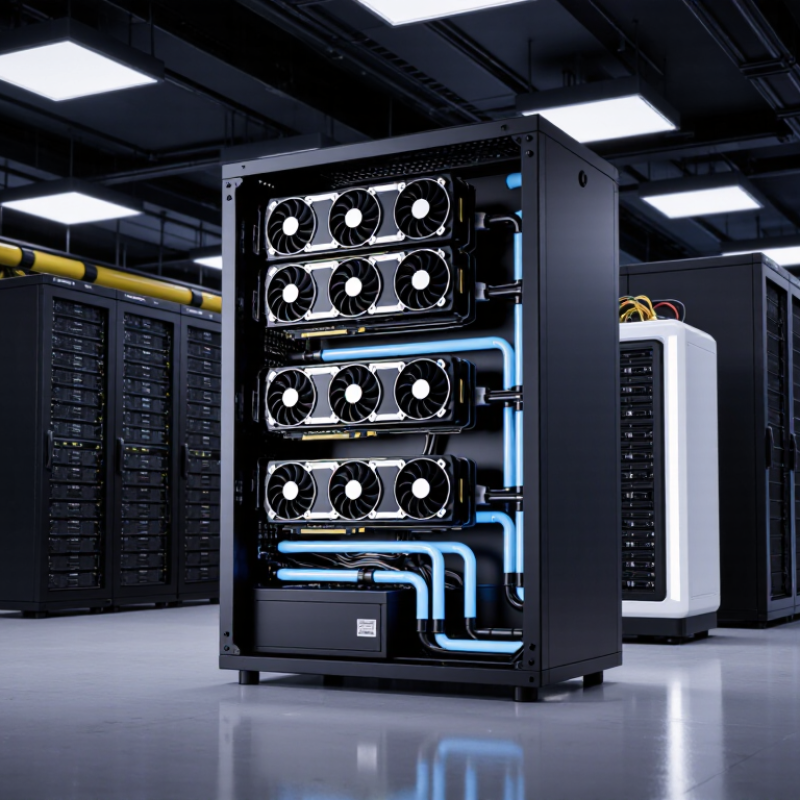
Choosing an AI server manufacturer starts with your workload, not a glossy specification sheet. Training, fine-tuning, and real-time inference require different designs. Training may need multiple accelerators, high-speed interconnects, and large memory capacity. Inference usually prioritizes predictable latency, energy efficiency, and fast response times. Record model size, batch volume, target latency, daily requests, and expected growth. Use real production traces when possible. Assumptions can be surprisingly wrong.
A practical evaluation should also include rack density, power limits, cooling capacity, storage speed, and network bandwidth. For example, a server drawing 8 kilowatts may exceed an older rack’s safe operating range. Ask manufacturers for measured performance under your workload, not only theoretical accelerator results. Request thermal data, firmware policies, repair procedures, spare-part availability, and support response times. Independent validation matters. A short benchmark can reveal memory bottlenecks, unstable drivers, or poor scaling between servers. No configuration is perfect.
Tips: Build a small test matrix before purchasing. Compare throughput per watt, latency at peak load, and recovery time after a component failure. Include your IT, facilities, and security teams in testing. They may identify constraints that performance engineers overlook. Recheck results after software updates, because efficiency and reliability can change. Keep a clear record of every setting, measurement, and unresolved concern.
Choosing a data center AI server manufacturer requires more than comparing processor counts. Evaluate its engineering expertise through deployment records, technical certifications, and support experience. Ask how the manufacturer handles thermal failures, firmware updates, and changing accelerator requirements. A reliable team should explain these issues clearly, not hide behind impressive specifications.
Product design reveals practical competence. Inspect airflow paths, rack density, power distribution, and component accessibility. A well-designed server should support quick maintenance without disturbing nearby systems. Check whether the chassis allows future upgrades, because today’s efficient configuration may become restrictive within two years. Review monitoring software, remote management, and compatibility with your existing network. Small design details matter. Cable placement can affect service time significantly.
Tips: Request performance data from workloads similar to yours. Test inference latency, training throughput, power consumption, and noise under sustained loads. Short demonstrations can mislead. Ask for longer benchmark sessions and documented testing conditions. Compare performance per watt, not only raw speed. Also, examine warranty response times and spare-parts availability in your region. These details often separate dependable manufacturers from capable-looking vendors. I have seen teams overvalue peak benchmark scores and underestimate cooling costs. That mistake is easy to repeat. Evaluation should remain evidence-based, even when the technical proposal sounds convincing.
How to Choose a Data Center AI Server Manufacturer?
Choosing a data center AI server manufacturer requires more than comparing processor counts. Start with workload evidence: model size, batch patterns, latency targets, and daily inference volume. Then inspect accelerator memory, CPU balance, PCIe lanes, network speed, storage throughput, and power draw. A server with impressive peak performance may throttle inside a warm rack. Thermal design matters. Ask for measured results under sustained workloads, not short benchmark bursts.
Scalability should be tested at both rack and cluster levels. Check whether identical nodes can be added without redesigning power, cooling, or network layouts. Review fabric topology, GPU communication bandwidth, and support for distributed training. Confirm expansion paths for memory, accelerators, local drives, and network adapters. A practical test uses your container images and representative datasets. Generic benchmarks can hide costly bottlenecks. Also calculate three-year operating costs, including electricity, maintenance, and technician time.
Integration options often determine whether deployment remains manageable. The manufacturer should support standard management interfaces, remote monitoring, firmware controls, and role-based access. Compatibility with orchestration platforms, existing storage, identity systems, and security logging reduces operational friction. Request documentation, update policies, spare-part targets, and escalation procedures before signing. Clear evidence builds trust. Still, no evaluation is perfect. Early estimates may miss software tuning or cooling limits, so leave room for pilot testing and revision.
Compare representative server classes by accelerator capacity, system memory, network bandwidth, and power demand. These specifications help evaluate hardware capability, future scalability, cooling requirements, and integration readiness without relying on a specific brand.
Higher accelerator and memory capacity supports larger AI models, while faster network connectivity improves distributed training and storage integration. Power demand should be checked against rack density, cooling infrastructure, and long-term operating costs.
Choosing a data center AI server manufacturer requires more than checking GPU performance. Reliability begins with evidence: failure rates, burn-in procedures, firmware controls, and documented thermal testing. The Uptime Institute’s 2024 Annual Outage Analysis reported that 54% of respondents experienced financial damage from their latest outage. Ask for incident records, replacement times, and clear escalation paths.
Security must cover the entire server lifecycle. Review secure boot, hardware root of trust, signed firmware, vulnerability response, and certified data destruction. The 2024 Cost of a Data Breach Report placed the global average breach cost at 4.88 million dollars. AI servers also process sensitive training data, so access logs and component traceability matter. A compliance certificate alone is not enough.
Support quality becomes visible during a failed overnight job. Test the manufacturer’s response with practical questions: Who answers at 2 a.m.? Are spare boards stored locally? Can engineers diagnose memory, network, and accelerator faults remotely? Lifecycle planning should include driver support, firmware longevity, cooling upgrades, and parts availability for five years or longer. I have seen impressive specifications age quickly when software support is weak. That risk is easy to underestimate. No scorecard is perfect; regional service capacity, staffing changes, and supply disruptions can still defeat a careful purchase. Request service-level evidence, not promises.
Choosing a data center AI server manufacturer requires more than comparing purchase prices. Total cost includes electricity, cooling, rack space, networking, software support, maintenance, and eventual replacement. A server drawing extra power during continuous model training can quietly increase monthly operating costs. Ask for measured power data at realistic workloads, not only laboratory figures. Request a sample maintenance invoice, too. Small fees often become large over five years.
Certifications provide useful evidence, but they are not a complete guarantee. Check whether the manufacturer maintains relevant quality, environmental, information security, and product safety certifications, such as ISO 9001, ISO 14001, ISO/IEC 27001, or regional compliance marks. Confirm their scope, issuing body, expiration date, and covered facility. A certificate copied into a sales presentation proves little. Independent audit records and clear documentation matter more. This is where buyers sometimes become careless.
Long-term manufacturer value depends on practical support. Review spare-parts availability, firmware policies, repair response times, warranty exclusions, and technical escalation procedures. Test whether the manufacturer supports open standards and common accelerator, storage, and network components. A five-year lifecycle plan should explain upgrade paths and responsible equipment retirement. However, forecasts can be wrong. I have seen attractive roadmaps change after supply shortages or platform updates. Leave room for that uncertainty, and require written service commitments before deployment. Reliable manufacturers discuss limitations openly, including thermal constraints, delivery risks, and workloads their systems may not handle well.
| Evaluation Dimension | Verification Method | Manufacturer Profile A Enterprise Integrator |
Manufacturer Profile B Specialist AI Vendor |
Manufacturer Profile C Regional System Builder |
Manufacturer Profile D Value-Focused OEM |
Weight |
|---|---|---|---|---|---|---|
| Three-Year Acquisition Cost | Request a configuration-level quotation covering server, GPUs, memory, storage, networking, rails, and implementation. | USD 260,000–340,000 | USD 230,000–310,000 | USD 210,000–285,000 | USD 190,000–265,000 | 15% |
| Three-Year Energy Cost | Calculate from measured system power, utilization, operating hours, cooling overhead, and local electricity price. | USD 85,000–125,000 | USD 80,000–118,000 | USD 88,000–130,000 | USD 92,000–138,000 | 10% |
| Three-Year Maintenance Cost | Review labor, spare parts, on-site support, response time, travel charges, and exclusions in the service agreement. | USD 45,000–70,000 | USD 38,000–62,000 | USD 50,000–78,000 | USD 55,000–85,000 | 10% |
| Estimated Three-Year TCO | TCO = acquisition cost + energy cost + maintenance cost + deployment cost + estimated downtime cost. | USD 390,000–535,000 | USD 348,000–490,000 | USD 365,000–515,000 | USD 337,000–488,000 | 15% |
| GPU Density and Thermal Design | Check validated GPU count, rack power, airflow requirements, liquid-cooling compatibility, and thermal-throttling test results. | Up to 8 GPUs Air or liquid cooling |
Up to 8 GPUs Advanced liquid cooling |
Up to 8 GPUs Air cooling standard |
4–8 GPUs Air cooling standard |
10% |
| Power Efficiency | Require measured performance-per-watt data using the intended workload, not only peak theoretical performance. | Strong Validated workload report |
Very strong Liquid-cooling optimization |
Good Standard efficiency profile |
Moderate Configuration dependent |
8% |
| Quality Management Certification | Verify a current certificate, issuing body, scope, site coverage, and certificate validity date. | ISO 9001 Certificate evidence required |
ISO 9001 Certificate evidence required |
ISO 9001 or equivalent Verify scope carefully |
Certificate may vary Verify before purchase |
7% |
| Information Security Controls | Review ISO/IEC 27001 certification or SOC 2 Type II report, supplier-access controls, and incident-notification procedures. | Usually available Scope must match service |
Available for managed services Verify report date |
May be limited Use contractual controls |
May be limited Request security questionnaire |
7% |
| Product Safety and Market Compliance | Confirm applicable declarations and test reports for electrical safety, electromagnetic compatibility, environmental compliance, and destination market rules. | CE / UKCA where applicable RoHS documentation |
CE / UKCA where applicable Safety test reports |
Regional compliance Documents vary by market |
Basic market compliance Verify destination requirements |
6% |
| Warranty and Service-Level Agreement | Compare warranty period, parts coverage, response time, resolution target, on-site support, and service-credit terms. | 3 years 4-hour response option |
3 years Next-business-day standard |
1–3 years Regional on-site support |
1–3 years Return-to-depot may apply |
8% |
| Spare-Parts Availability | Request local inventory levels, guaranteed stocking period, replacement-part lead time, and end-of-life notification policy. | High Multi-region inventory |
Medium to high Specialist parts planning |
Medium Regional warehouse |
Low to medium Import lead time possible |
6% |
| Firmware, BIOS, and Security Updates | Check release cadence, signed firmware, vulnerability response process, update documentation, and rollback procedures. | Formal lifecycle process Quarterly review typical |
Fast specialist updates Confirm long-term coverage |
Standard vendor updates Process maturity varies |
Basic update program Verify security ownership |
6% |
| Deployment and Integration Capability | Evaluate rack installation, cluster imaging, scheduler integration, monitoring, acceptance testing, and documentation. | Excellent Full data-center integration |
Very good AI cluster specialization |
Good Project-based delivery |
Basic to good Customer-led integration |
5% |
| Manufacturer Longevity and Financial Stability | Review operating history, audited financial information where available, ownership structure, customer references, and continuity planning. | High Established service network |
Medium to high Strong technical focus |
Medium Regional dependency |
Medium Higher continuity risk |
5% |
| Platform Upgradeability | Assess support for future GPU generations, CPU upgrades, memory expansion, network upgrades, and backward-compatible chassis design. | High Modular platform roadmap |
High for AI modules Roadmap confirmation required |
Medium Selected components replaceable |
Low to medium Chassis-specific limits |
3% |
| Reference Workloads and Acceptance Testing | Require reproducible tests using the buyer’s model, batch size, precision, dataset, interconnect, and target utilization. | Documented Enterprise acceptance process |
Strong AI-focused benchmarking |
Available on request Project dependent |
Limited Customer test required |
5% |
| Suggested Decision Priority | Use a weighted score after validating all documentation and conducting a workload proof of concept. | Best for regulated enterprise environments |
Best for high-density AI clusters |
Best for regional support requirements |
Best for budget-led deployments |
100% |
Record model size, batch patterns, latency targets, and daily inference volume. Use your own datasets. These details reveal bottlenecks better than peak processor counts.
Check accelerator memory, CPU balance, PCIe lanes, network speed, storage throughput, and power draw. Thermal design matters. A server may throttle inside a warm rack.
Test expansion at rack and cluster levels. Confirm identical nodes fit existing power, cooling, and network layouts. Check memory, accelerator, drive, and adapter expansion paths. Plans can fail later.
Look for standard management interfaces, remote monitoring, firmware controls, and role-based access. Confirm compatibility with orchestration, storage, identity, and security logging systems. Missing one interface can create manual work.
Request failure rates, burn-in procedures, thermal test results, and incident records. Ask how quickly replacement parts arrive. A failed overnight job needs a clear response path.
Review secure boot, hardware root of trust, signed firmware, and vulnerability response. Require access logs and component traceability. Certificates alone are not enough.
Ask who responds during overnight failures. Check local spare boards and remote fault diagnosis. Request escalation procedures, update policies, and service-level evidence. Promises are not evidence.
Include electricity, maintenance, technician time, cooling, and replacement parts. Also estimate software tuning and network changes. Early estimates can be wrong.
Plan for driver support, firmware longevity, cooling upgrades, and parts availability for five years or longer. Software support may weaken first. No checklist is perfect.
Choosing the right data center ai server manufacturer begins with a clear understanding of your organization’s workloads, including AI training, inference, analytics, and virtualization requirements. Define expected performance, data volumes, power limits, cooling conditions, and future growth before comparing suppliers. Next, evaluate each manufacturer’s engineering expertise, product architecture, processor and accelerator options, memory capacity, storage flexibility, networking capabilities, and support for scalable deployments and existing infrastructure integration.
A dependable manufacturer should also provide strong reliability testing, security controls, remote management, warranty coverage, technical support, and lifecycle services such as upgrades and replacement planning. Consider certifications, compliance documentation, energy efficiency, delivery capabilities, and the availability of customized configurations. Finally, compare total cost of ownership rather than focusing only on the purchase price. A well-selected partner should offer predictable maintenance costs, consistent product availability, responsive service, and a long-term roadmap that supports operational continuity and evolving AI demands.
